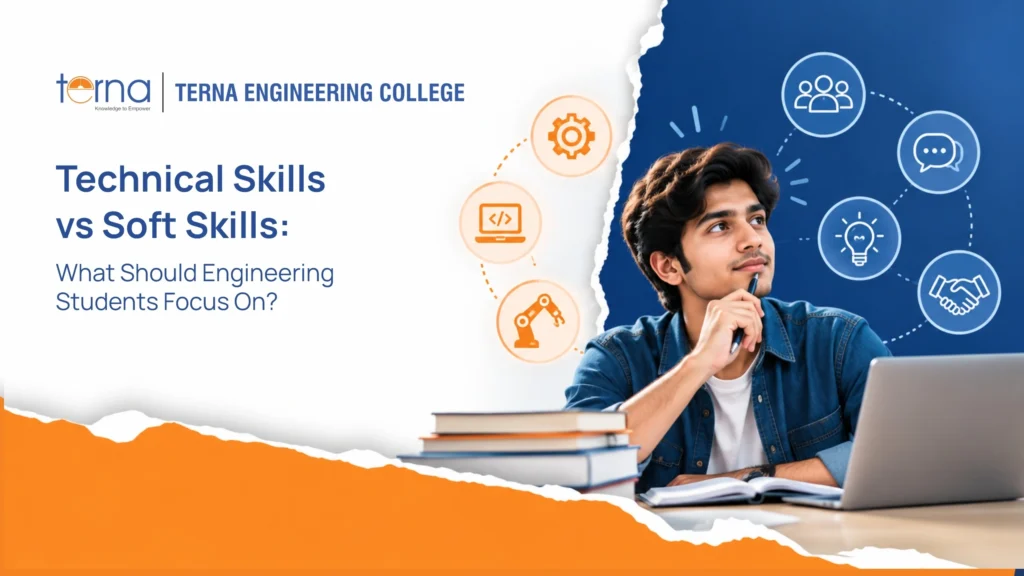
Engineering students need more than technical knowledge to prepare for their careers. Technical skills for engineering students help them apply engineering concepts and solve technical problems, while soft skills for engineering students support communication, teamwork and professional interaction.
So, technical skills vs soft skills for engineering students—which should they focus on?
Both are important. The right balance depends on the student’s engineering branch, career goals and stage of study.
Table of Contents
ToggleWhat Are Technical Skills for Engineering Students?
Technical skills are subject-specific abilities developed through engineering education, practical learning and projects. The skills required for engineering students vary by branch.
Examples include:
- Computer Engineering: Programming, databases and networking
- E&TC Engineering: Electronics, communication systems and embedded systems
- Mechatronics: Robotics, automation and control systems
- Mechanical Engineering: CAD, manufacturing and machine design
- Civil Engineering: Structural analysis, surveying and construction
Students should first build strong engineering fundamentals and then develop technical skills related to their chosen career.
What Are Soft Skills for Engineering Students?
Soft skills help students communicate, collaborate and work effectively in professional environments.
Important soft skills for engineering students include:
- Communication skills
- Teamwork
- Problem-solving
- Critical thinking
- Time management
- Adaptability
- Leadership
- Presentation skills
Students can develop these engineering student skills through projects, presentations, internships, technical clubs and group activities.
Why Do Engineering Students Need Both Technical and Soft Skills?
The importance of technical and soft skills in engineering comes from how they complement each other.
Technical Skills | Soft Skills |
Build technical knowledge | Improve communication |
Solve engineering problems | Support teamwork |
Develop through projects and practical learning | Develop through interaction and practice |
Often depend on the engineering branch | Useful across most career paths |
Demonstrate technical capability | Support professional effectiveness |
For example, a student may build a technically strong project but still need communication and presentation skills to explain the problem, contribution, challenges and results during an interview.
What Skills Should Engineering Students Focus On Each Year?
Students can gradually develop both technical and soft skills throughout college.
Year | Technical Focus | Soft Skill Focus |
First Year | Engineering fundamentals and digital basics | Communication and confidence |
Second Year | Branch-specific concepts and technical tools | Teamwork and time management |
Third Year | Projects, internships and career-specific skills | Presentation and professional communication |
Final Year | Role-specific knowledge and interview preparation | Workplace communication and collaboration |
This gradual approach helps students build career readiness instead of trying to develop every skill just before graduation.
How Can Engineering Students Develop Technical Skills?
Technical skills become stronger when students apply classroom knowledge.
Students can:
- Work on practical engineering projects
- Use laboratory facilities
- Participate in technical competitions
- Complete relevant internships
- Practise industry tools and technologies
- Build prototypes or applications
- Take relevant certifications selectively
The focus should be on applying technical knowledge, not simply collecting certificates.
How Can Engineering Students Develop Soft Skills?
Students can develop soft skills through regular practice in academic and extracurricular activities.
They can:
- Present projects and technical topics
- Participate in group discussions
- Work in project teams
- Take responsibility in technical clubs
- Attend workshops and industry sessions
- Practise interview conversations
- Write professional emails
- Learn to explain technical concepts clearly
These activities help students develop communication, teamwork, leadership and adaptability.
How Do Technical and Soft Skills Help in Engineering Placements?
Technical and soft skills for engineering placements support different stages of the recruitment process.
Technical assessments may evaluate:
- Engineering fundamentals
- Programming or technical tools
- Problem-solving
- Subject knowledge
- Project understanding
Other recruitment stages may assess:
- Communication
- Teamwork
- Confidence
- Professional behaviour
- Ability to explain ideas
Students therefore need both the knowledge to solve problems and the communication skills to explain their approach.
How Can Engineering Students Decide Which Skills to Prioritise?
Students asking what skills should engineering students focus on can use a simple approach:
- Build strong technical fundamentals.
- Apply them through projects and practical learning.
- Develop communication alongside technical skills.
- Gain industry exposure through internships.
- Strengthen interview and professional skills before graduation.
The priority can change according to the student’s branch and target career. A student preparing for a technical role may need deeper subject-specific skills, while a role involving clients or technical consulting may require stronger communication and presentation skills.
Why Should Students Develop These Skills Before Graduation?
Starting early gives students more time to practise and improve their engineering career skills.
First-year students can focus on engineering fundamentals and communication. In later years, they can add projects, internships, specialised technical skills and interview preparation.
By final year, students can connect their technical knowledge and professional skills with their target career.
How Can Terna Engineering College Support Skill Development?
For students looking to develop both technical knowledge and professional skills, Terna Engineering College, Navi Mumbai offers engineering programmes across disciplines including Computer Engineering, Information Technology, Artificial Intelligence & Data Science, Electronics and Telecommunication Engineering, Mechatronics, Mechanical and Civil Engineering.
Through laboratories, projects, technical activities, internships, industry exposure and student initiatives, students can apply classroom learning while developing problem-solving, communication and teamwork skills. These opportunities can support career readiness, professional development and engineering career preparation.
Frequently Asked Questions
Technical skills are subject-specific abilities used to perform engineering tasks, while soft skills support communication, teamwork, problem-solving and professional interaction.
Both contribute to career preparation. Technical skills build subject knowledge and problem-solving ability, while soft skills help students communicate, collaborate and work effectively.
Students should build strong engineering fundamentals and then develop career-relevant skills such as programming, CAD, electronics, embedded systems, automation or other specialised tools based on their branch.
Yes. Depending on the recruitment process, students may need to explain projects, communicate clearly, participate in discussions and demonstrate professional behaviour.
Students can work on projects, use laboratories, complete internships, practise technical tools, participate in group activities, present their work and take part in technical clubs and industry interactions.