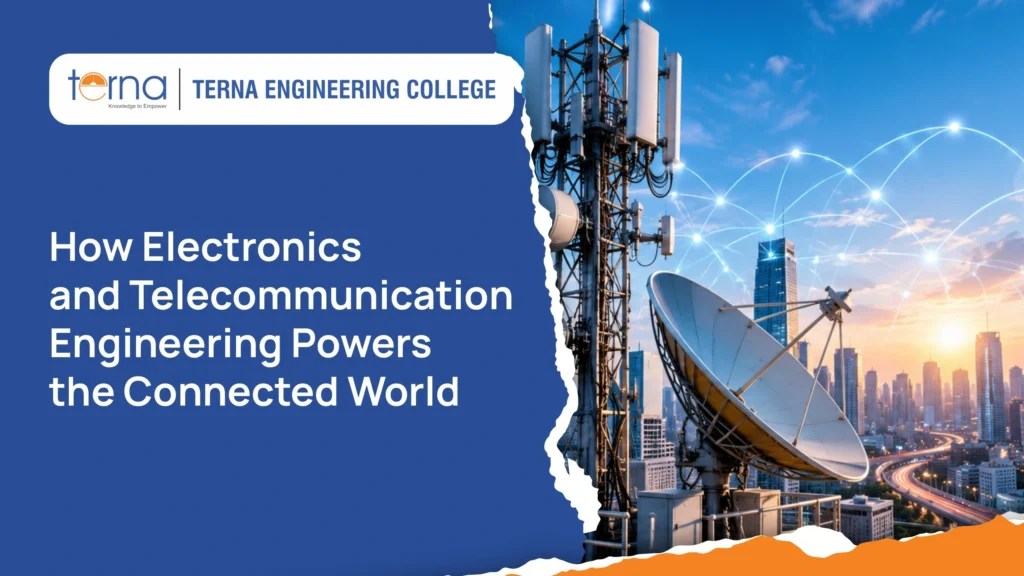
Smartphones, smartwatches, connected appliances, vehicles and video calls are now part of everyday life. The importance of Electronics and Telecommunication Engineering can be seen behind these technologies, where electronics, communication systems and networking work together to connect devices and exchange information. This makes Electronics and Telecommunication Engineering an important field in modern technology.
Table of Contents
ToggleWhat Is Electronics and Telecommunication Engineering?
Electronics and Telecommunication Engineering, commonly known as E&TC Engineering, combines electronics, communication and networking technologies to develop systems that process, transmit and receive information.
Students learn concepts related to:
- Analog and digital electronics
- Communication systems
- Wireless communication
- Embedded systems
- Microprocessors and microcontrollers
- Signal processing
- Networking
- Internet of Things (IoT)
- Optical and microwave communication
This interdisciplinary foundation helps students understand how electronic devices communicate and operate within connected systems.
What Is the Role of Electronics and Telecommunication Engineering in Modern Technology?
The role of Electronics and Telecommunication Engineering in modern technology extends from electronic devices to communication networks.
Electronic circuits and sensors allow devices to collect and process information, while communication technologies allow that information to move between devices and systems.
For example, a smartwatch can use sensors to collect data, electronic components to process it and wireless communication to transfer the information to another connected device.
These technologies are also used in smart homes, vehicles, medical equipment, industrial machines and consumer electronics.
How Does Telecommunication Support the Connected World?
Telecommunication engineering focuses on technologies that enable the transmission of voice, video and data across networks.
Important technologies include:
- Wireless communication
- Optical fibre communication
- Satellite communication
- Mobile networks
- Communication networks
Mobile communication has evolved through technologies such as 5G, while research and development continues toward future communication technologies including 6G.
These systems support the growing number of connected devices and digital services used across industries.
How Is E&TC Engineering Connected to IoT?
The Internet of Things (IoT) connects physical devices to digital networks so they can collect and exchange information.
An IoT system may use sensors, microcontrollers, embedded systems, communication modules and networking technologies.
For example, connected agricultural systems can monitor soil conditions, smart home devices can respond to commands, and industrial machines can send operational data for monitoring.
This demonstrates how Electronics and Telecommunication Engineering contributes to connected and smart technology.
What Technologies Can E&TC Students Explore?
An Electronics and Telecommunication Engineering course can provide exposure to several technology areas.
Technology Area | What Students Can Explore |
Embedded Systems | Microcontrollers, hardware-software integration and device control |
IoT | Sensors, connected devices and communication networks |
Wireless Communication | Mobile and wireless data transmission |
Signal Processing | Processing audio, images and communication signals |
Digital Electronics | Digital circuits and electronic systems |
Semiconductor Technology | Electronic devices and chip-based technologies |
Optical Communication | Fibre-optic communication and data transmission |
Students can also explore networking, microwave communication, antenna systems and other areas depending on their interests and coursework.
What Skills Should Students Develop for an E&TC Engineering Career?
Students preparing for an E&TC engineering career can develop skills in:
- Digital and analog electronics
- Communication systems
- Wireless communication
- Microcontrollers and embedded programming
- Networking and IoT
- Signal processing
- Digital system design
- Technical problem-solving
- Project development
Practical projects can help students apply these skills to real engineering systems and develop experience in solving technical problems.
Why Is Practical Learning Important in E&TC Engineering?
Practical learning helps students understand how electronics and communication concepts work outside the classroom.
Building electronic circuits, programming microcontrollers, developing IoT projects and testing communication systems can help students connect theoretical knowledge with real applications.
At Terna Engineering College, Navi Mumbai, laboratory work and practical activities provide exposure to areas such as electronics, communication systems, simulation and microprocessor-based systems.
What Are the Career Opportunities After Electronics and Telecommunication Engineering?
The interdisciplinary nature of E&TC Engineering allows graduates to explore different technology-focused roles.
Career Area | Possible Roles |
Telecommunication | Telecom Engineer, Network Engineer |
Embedded Systems | Embedded Systems Engineer |
Electronics & VLSI | Electronics Design Engineer, VLSI Engineer |
IoT & Connected Technology | IoT Engineer |
Communication Systems | Communication Systems Engineer |
Networking | Network Engineer |
The career opportunities after Electronics and Telecommunication Engineering depend on factors such as technical skills, projects, internships and specialisation.
What Is the Future of Electronics and Telecommunication Engineering?
The future of Electronics and Telecommunication Engineering is closely connected with technologies such as IoT, wireless communication, embedded systems, semiconductor technology, connected devices and smart technology.
As more devices and systems become digitally connected, engineers with knowledge of electronics and communication can contribute to developing, testing and maintaining these technologies.
This is also relevant to the future of E&TC Engineering in India, where students can build specialised skills in areas such as communication systems, embedded technology, IoT and electronics.
For students asking why study Electronics and Telecommunication Engineering, the field offers exposure to multiple technology areas rather than focusing on a single engineering discipline.
Frequently Asked Questions
Electronics and Telecommunication Engineering combines electronics, communication systems and networking technologies to develop systems that process, transmit and receive information.
The importance of Electronics and Telecommunication Engineering comes from its role in technologies such as wireless communication, IoT, embedded systems, connected devices and digital electronics.
Yes. E&TC covers communication principles and technologies relevant to wireless and mobile communication. Students can develop specialised knowledge in areas related to current and emerging communication technologies.
Useful skills include electronics fundamentals, communication systems, programming, microcontrollers, networking, IoT, signal processing and technical problem-solving.
Graduates can explore telecommunications, embedded systems, IoT, networking, electronics design, VLSI and communication systems, depending on their skills and area of specialisation.